
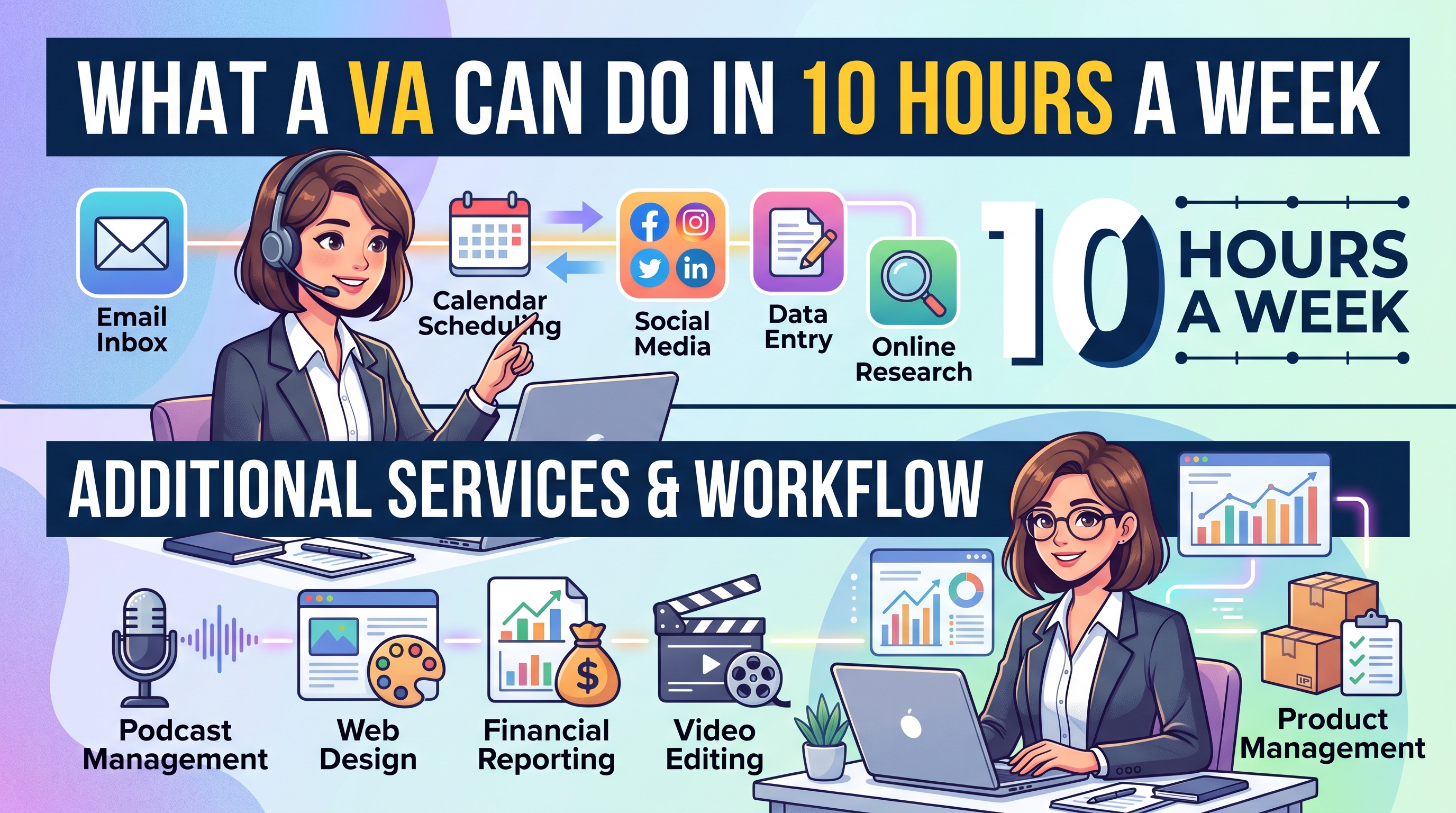
What a VA Can Do in Just 10 Hours a Week
Ten hours a week might sound modest. But in the hands of a skilled virtual assistant, it's enough to transform how a business owner spends their time — and how their business grows.
One of the most common hesitations business owners have about hiring a virtual assistant is scale. "I don't have enough work for a full-time hire." "I'm not sure I need someone every day." "Maybe when the business is bigger."
The reality is that you don't need a full-time VA to see a full-time impact. Ten hours a week — just two hours a day — is enough time for a skilled VA to handle the tasks that are quietly draining your focus, consuming your mornings, and keeping you from the work that actually grows your business.
This blog breaks down exactly what's possible in 10 hours — from both the client's perspective and the VA's. Because the better both sides understand what a part-time engagement can achieve, the better the working relationship becomes.
Why 10 Hours Is More Than You Think
Ten hours a week is 40 hours a month. That's a full working week returned to your calendar every single month. The question is not whether 10 hours is enough — it's whether you're using those hours on the right things.
Research consistently shows that professionals spend an average of 2–3 hours per day on tasks that could be delegated — email management, scheduling, administrative follow-ups, social media, and routine communications. That's 10–15 hours a week of work that doesn't require your unique expertise, judgment, or relationships.
A VA working 10 hours a week can absorb all of that — and give it back to you as focused, uninterrupted time.
What a VA Can Do With 10 Hours a Week
The specific tasks will depend on your business, your needs, and your VA's skill set. But here are some of the most common — and most impactful — ways a VA can use 10 hours a week.
Inbox and email management (2–3 hrs/week)
A VA can sort, label, and prioritize your inbox daily; draft responses to routine inquiries using approved templates; flag anything requiring your direct attention; and unsubscribe from irrelevant lists. For many business owners, this alone recovers an hour or more every day.
Calendar management and scheduling (1–2 hrs/week)
Coordinating meetings, managing time zones, sending confirmations, rescheduling conflicts, and protecting your focus time — a VA handles the back-and-forth so you don't have to. By the time a meeting appears on your calendar, all the logistics have already been handled.
Social media scheduling and engagement (2–3 hrs/week)
Once you establish your brand voice and content direction, a VA can schedule posts across platforms, respond to standard comments and messages, track basic engagement metrics, and source relevant content to share. You stay visible and consistent without spending hours on the platforms yourself.
Research and data gathering (1–2 hrs/week)
Whether you need competitor research, vendor comparisons, contact lists, industry data, or travel options, a VA can compile structured, usable information on demand. Instead of spending an afternoon going down research rabbit holes, you receive a clean summary and can make decisions in minutes.
Document preparation and admin support (1–2 hrs/week)
Formatting reports, preparing presentation decks, transcribing meeting notes, updating spreadsheets, managing files — these are time-consuming tasks that rarely require your direct involvement. A VA can handle all of it, keeping your operations running smoothly in the background.
Task Area Hours/Week What Gets Done
Email management 2–3 hrs Sorting, drafting, flagging, unsubscribing
Calendar & scheduling 1–2 hrs Meetings, confirmations, rescheduling
Social media 2–3 hrs Scheduling, engagement, metrics
Research 1–2 hrs Competitors, contacts, data, travel
Admin & documents 1–2 hrs Reports, decks, notes, files
From the VA's Perspective: Making 10 Hours Count
For virtual assistants, a 10-hour-per-week engagement is an opportunity to demonstrate real, measurable impact in a focused scope. The key is structure.
The most effective VAs in part-time roles do three things consistently:
- They prioritize ruthlessly. With limited hours, every task needs to deliver clear value. A good VA will regularly review what's on their plate and flag anything that should be deprioritized or handled differently.
- They communicate proactively. A brief daily or every-other-day check-in — even a short message summarizing what was completed and what's next — keeps the client informed without requiring meetings.
- They document everything. In a part-time engagement, institutional knowledge is precious. Good VAs create SOPs (standard operating procedures) for recurring tasks so that nothing depends on memory, and everything can scale.
A 10-hour engagement done well is also a pathway to more hours. Clients who see clear results from a part-time VA almost always expand the scope over time.
What Clients Get Back
The ROI of a 10-hour VA engagement isn't just in the tasks completed. It's in what those tasks were replaced with.
When a business owner stops spending two hours a day on email, scheduling, and admin, they don't just save time. They recover the mental energy, focus, and clarity to do the work that actually moves the needle — business development, client relationships, strategy, creativity.
Consider this: if your time is worth $127 per hour and a VA frees up 10 hours a week, that's $1,270 in recovered value every week — from an engagement that might cost $190–$320 per week at a mid-level rate. The return is not marginal. It's significant.
And that's before you factor in the less tangible returns — reduced stress, faster response times to clients, a more consistent social media presence, and the compounding effect of operating at your best rather than your most stretched.
Is a 10-Hour Engagement Right for You?
A 10-hour per week engagement works best when:
- You have a clear set of recurring tasks that don't require your direct involvement
- You're willing to spend time upfront onboarding your VA properly
- You have consistent enough workload to keep 10 hours occupied each week
- You're open to starting small and scaling as trust builds
If you're unsure whether 10 hours is the right starting point, begin by tracking how you spend your time for one week. Highlight every task you completed that didn't require your specific expertise or authority. That's your delegation list — and it's almost certainly more than 10 hours.
Start Small. Think Big.
Ten hours a week is where many of the best VA relationships begin. Not because the scope stays small — but because starting with a focused, well-defined engagement allows trust to build, processes to develop, and results to speak for themselves.
For business owners, it's the lowest-risk entry point into one of the highest-return professional partnerships available. For VAs, it's the chance to prove — in clear, measurable terms — exactly what you're capable of.
Ten hours a week. Two hours a day. It's more than enough to change everything.
Up Next: How to Set Your Rates as a VA — and Stop Undercharging for Your Time
© 2026 Michelle Kearney, Visionary Flare. All rights reserved. Originally published at www.visionaryflare.com. No part of this article may be reproduced or distributed without written permission from the author.