
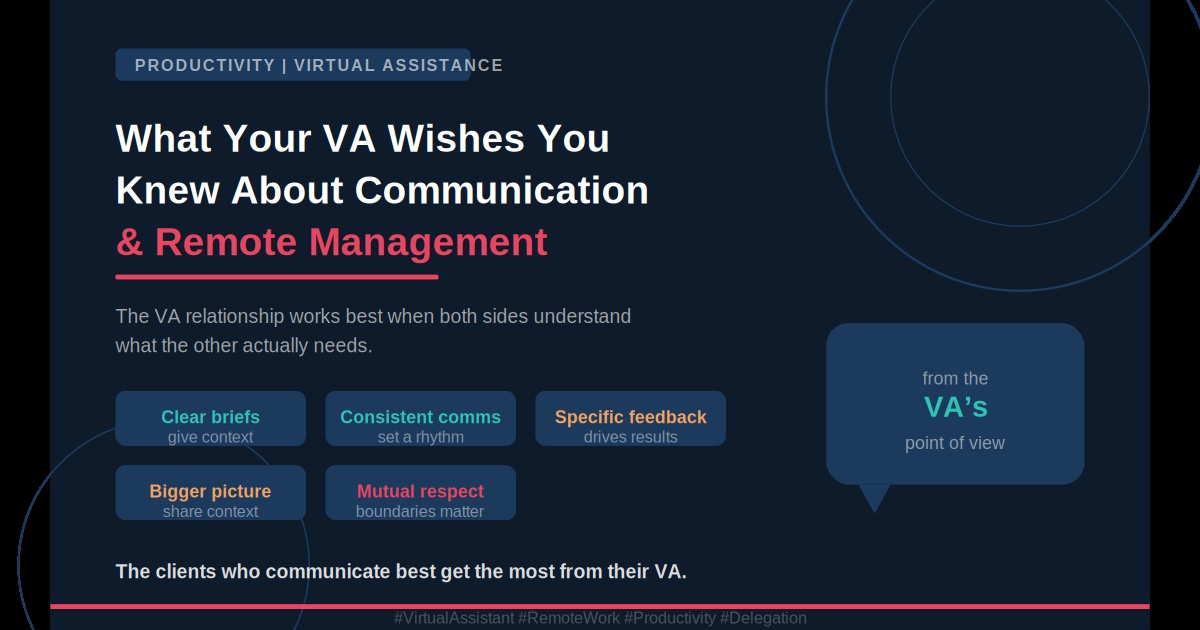
What Your VA Wishes You Knew About Communication and Remote Management
The virtual assistant (VA) relationship works best when both sides understand what the other actually needs. While a lot has been written about how to manage a VA—how to delegate effectively, set expectations, and get the most out of the partnership—very little is shared from the other side of the screen.
As a virtual assistant working with clients across various industries and time zones, I’ve experienced communication styles that make the work feel effortless, and others that make even simple tasks feel impossible. The difference almost never comes down to the complexity of the work itself ; it comes down to how the relationship is managed.
Here is what your VA wishes you knew about communication, clarity, and what it actually takes to build a remote working relationship that lasts.
1. Clarity Is the Most Valuable Thing You Can Give Us
When a task arrives without context, we don't just get confused—we lose time. We spend that time guessing what you meant, second-guessing our output, and often redoing work that would have been right the first time if we had the full picture.
A clear brief doesn't need to be long. It just needs to answer four simple questions:
- What do you need? Be specific about the exact output you want, not just the general topic.
- Why does it matter? Understanding the purpose of the task helps us make better decisions along the way.
- What does "done" look like? A shared definition of success saves everyone time.
- When do you need it? Provide real deadlines, not just "whenever you get a chance".
The clients who take just two minutes to brief a task properly end up saving hours of revisions on both sides.
2. Consistent Communication Beats Constant Check-Ins
There is a common misconception that managing a remote VA requires checking in frequently throughout the day. In reality, excessive check-ins are one of the fastest ways to erode productivity and trust.
What works far better is a predictable communication rhythm. When there is a set schedule, a VA can structure their work around it, knowing exactly when to flag issues, when to wait, and when to push ahead independently. Unpredictable, sporadic messages at all hours and urgent requests without warning create anxiety and disrupt deep, focused work.
The best working relationships follow a simple, structured routine:
- A brief daily or every-other-day check-in (5–10 minutes) to align on priorities.
- A weekly review to assess completed work, upcoming tasks, and feedback.
- A clear, dedicated channel for urgent matters, with a shared understanding of what "urgent" actually means.
- Agreed-upon response time expectations on both sides.
Structure isn't micromanagement—it’s respect for both people's time.
3. Feedback Is a Gift (But Only When It's Specific)
Vague phrases like "This isn't quite right" or "Can you redo this?" without an explanation do not qualify as helpful feedback. These responses leave your VA in the dark, unable to course-correct, unable to improve, and quietly frustrated.
Specific feedback, on the other hand, is one of the most powerful tools in a remote working relationship. It clarifies the standards you are working toward, helps us calibrate, and ultimately reduces the number of future revisions.
When something isn't quite what you were looking for, try using actionable phrasing:
- "The tone here is too formal; I'd like it to feel more conversational."
- "This covers the right points but runs too long. I was expecting a summary, not a full breakdown. Can you cut it by a third?"
- "Here's an example of what I mean."
Equally important: when something is right, say so. Positive feedback isn't just encouragement; it tells us exactly what success looks like so we can replicate it next time. A quick "this is exactly what I needed" goes a long way.
4. We Work Best When We Understand the Bigger Picture
One of the most common frustrations for virtual assistants is working in isolation—completing tasks without ever understanding why they matter, what business goal they serve, or how they connect to the larger strategy.
When we understand the bigger picture, everything changes. We stop being simple task-completers and start being true contributors. We notice opportunities you might have missed, make better decisions in grey areas, and bring proactive ideas to the table.
You don't need to share every confidential detail. However, sharing your goals for the quarter, the broader context behind a project, or simply who the end client is can have an outsized impact on the quality of the work.
5. Respect for Boundaries Goes Both Ways
Remote work is flexible by nature, but flexibility is not the same as 24/7 availability. Virtual assistants work best when they have defined working hours, reasonable notice for new tasks, and clarity about deadlines.
Clients who get the absolute best results treat the relationship as a professional partnership, not an on-demand service. They plan ahead, give advanced notice before major workload spikes, and respect agreed-upon hours without expecting midnight responses (unless explicitly discussed and compensated).
In return, a great VA will communicate proactively about their capacity, flag roadblocks early, and happily go the extra mile when it genuinely matters. That reciprocity is what makes a remote relationship sustainable and exceptional.
Summary: What the Best Client Relationships Share
In every successful VA-client partnership, a few core principles are always true:
- Tasks are briefed clearly with context and defined outcomes.
- Communication follows a predictable, agreed-upon rhythm.
- Feedback is specific, timely, and delivered constructively.
- The VA is treated as a professional contributor, not just a task-taker.
- Boundaries are respected, and expectations are discussed openly rather than assumed.
None of these practices are complicated, but they do require intentionality—especially in a remote setting where the usual face-to-face cues of office life don't exist.
At its best, a VA relationship is one of the most effective professional partnerships you can build, freeing up your time and extending your capacity so you can operate at your highest level. But like any relationship, it requires an investment of clear communication and mutual respect. When you protect and nurture that partnership, the investment pays back every single time.
© 2026 Visionary Flare. All rights reserved.