
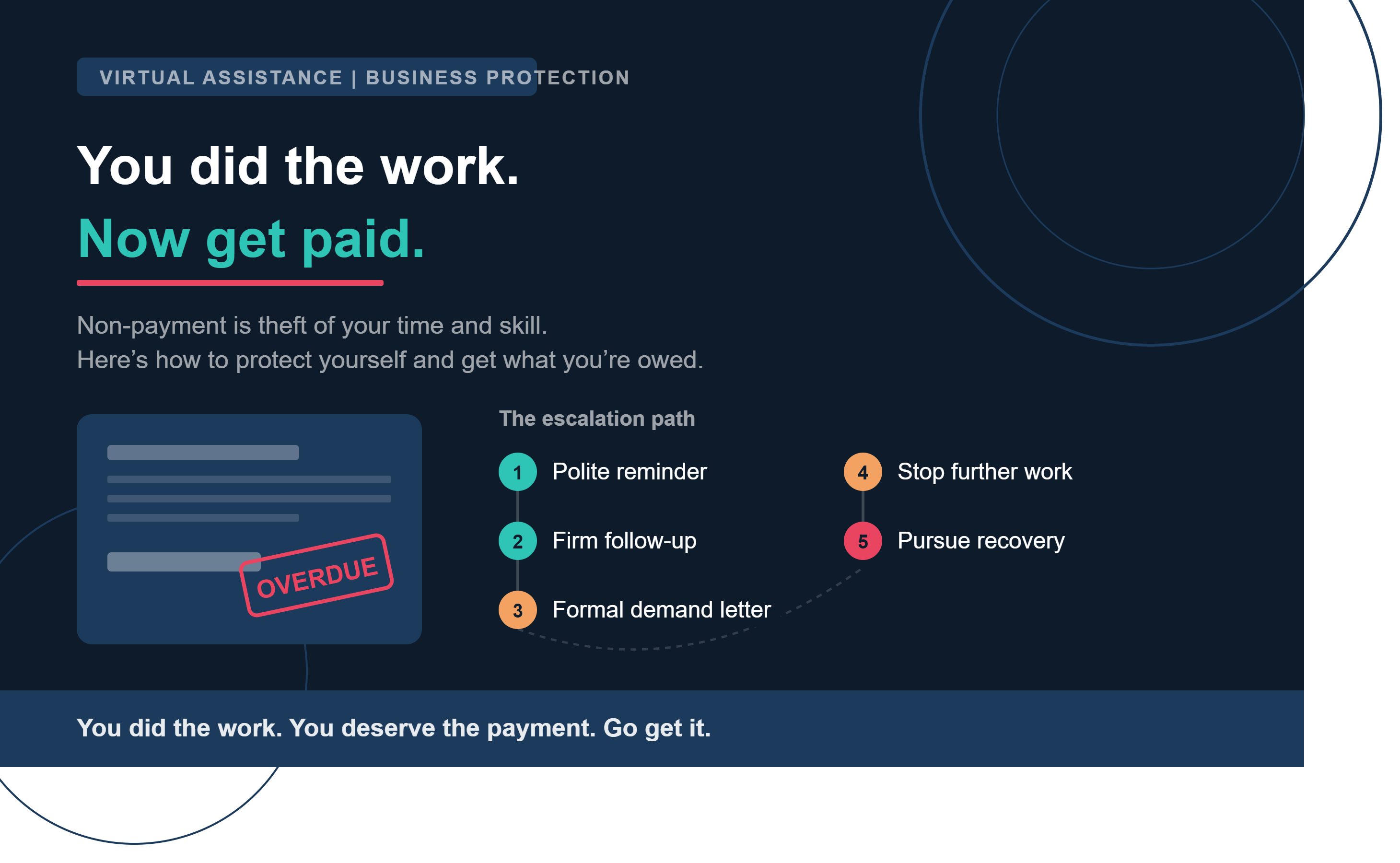
You Did the Work. Now Get Paid.
Non-payment is one of the most common—and most damaging—experiences a virtual assistant can face. Here's how to protect yourself, handle it professionally, and make sure it never happens twice.
You took the brief. You asked the right questions. You delivered the work on time, to standard, exactly as agreed.
And then... nothing. The invoice sits unanswered. Messages go unread. The client who was so enthusiastic before the work was done has suddenly become very difficult to reach.
If you're a virtual assistant, the chances are you've experienced this—or you know someone who has. Non-payment is one of the most frustrating, demoralizing, and frankly disrespectful experiences in freelance work, and it happens far more often than it should.
This blog is for every VA who has ever been left chasing money they earned. We're going to talk about why it happens, what you can do about it, and most importantly, how to protect yourself so it never happens again.
Your time is valuable. Your work has worth. And you deserve to be paid for it.
Let's Name What This Actually Is
Before we get into the practical steps, let's be clear about something: when a client uses your work and doesn't pay you, that is not a misunderstanding. It is not a cash flow issue on their end that you need to be patient about indefinitely. It is not your fault for not following up sooner.
It is theft of your time, your skills, and your labor.
Some clients do this deliberately—they never intended to pay. They take advantage of the fact that many VAs, especially those new to the industry, are reluctant to push back for fear of damaging the relationship or their reputation. Others are simply disorganized, financially stretched, or treat freelancers as a lower priority than their other obligations.
Whatever the reason, the outcome is the same: you are owed money that you earned. And you have every right to pursue it.
Red Flags to Watch Before It Happens
The best time to protect yourself from non-payment is before you start the work. Here are the warning signs that a client may not be reliable:
- They resist signing a contract or agree to "sort it out later."
- They push back on upfront deposits or request payment terms that heavily favor them.
- They have vague answers about budget, timeline, or scope.
- They rush you into starting before any formal agreement is in place.
- They ask for a "trial task" before committing—especially if it's unpaid.
- They have negative reviews from other freelancers online, or can't provide references.
- They make you feel guilty for asking about payment terms.
Trust your instincts. If something feels off before the work starts, it will almost certainly feel worse after.
Protect Yourself Before You Start Any Work
The single most powerful thing you can do as a VA is put the right structures in place before a single task is completed. These are not optional extras—they are the foundation of a professional, protected business.
1. Always use a written contract
A contract does not need to be lengthy or complicated. It needs to clearly state the scope of work, the agreed rate, the payment terms, the due date, and what happens if payment is late. No contract means no legal protection. Full stop. If a client refuses to sign a basic agreement, that tells you everything you need to know about how they will treat you.
2. Require a deposit upfront
Charging 25–50% upfront is standard practice for freelancers and is entirely reasonable to request. A deposit serves two purposes: it confirms the client is serious, and it ensures you are partially compensated even if the relationship breaks down. Clients who refuse a deposit are a significant red flag.
3. Invoice clearly and promptly
Send your invoice immediately upon completing work or at the agreed billing interval. Make sure your invoice includes your name and contact details, a clear description of the work completed, the amount due, your payment details, and a specific due date—not just "30 days." The clearer and more professional your invoice, the harder it is for a client to claim confusion.
4. Include late payment terms
State in your contract and on your invoice what happens if payment is late. A standard late fee is 1.5–2% per month on the outstanding balance. The existence of a late fee alone is often enough to encourage on-time payment.
What to Do When a Client Doesn't Pay
Despite your best precautions, non-payment can still happen. Here is a step-by-step approach to handling it professionally while making clear that you will not be ignored.
Step 1: Send a polite payment reminder
As soon as a payment becomes overdue, send a calm, professional reminder. Keep it factual: reference the invoice number, the amount owed, the original due date, and your payment details. Assume good faith at this stage—sometimes invoices genuinely get lost or overlooked.
Step 2: Follow up directly and firmly
If you receive no response within 3–5 business days, follow up again—this time more directly. State that the invoice is now overdue, reference your contract's late payment terms, and give a clear deadline for payment. Move from email to a phone call or voice message if necessary. Make it harder to ignore.
Step 3: Send a formal demand letter
If payment is still not received, send a formal letter of demand. This is a written statement that you are owed a specific amount, that it is now significantly overdue, and that you will take further action if it is not settled by a specific date. This letter creates a paper trail and signals that you are serious.
Step 4: Cease all further work immediately
Stop. Do not continue working for a client who has not paid you for previous work. This seems obvious, but many VAs continue delivering out of professionalism or hope. A client who hasn't paid for last month's work will not suddenly pay for this month's either. Protect yourself.
Step 5: Explore your options for recovery
If the client still does not pay, you have several options depending on the amount owed and your location:
- Small claims court: For amounts under a certain threshold (varies by country/state), small claims court is a relatively straightforward and low-cost option that does not require a lawyer.
- Freelancer platforms: If you were hired through a platform like Upwork or Fiverr, use their dispute resolution process immediately.
- Debt collection agencies: For larger amounts, a collections agency can pursue payment on your behalf, typically taking a percentage of what is recovered.
- Legal action: If the amount is significant and you have a signed contract, a solicitor's letter or formal legal claim may be appropriate.
- Public review: As a last resort, leaving honest reviews on relevant platforms (Google, Trustpilot, freelancer forums) warns other VAs about non-paying clients. Do this factually and without personal attacks.
How to Make Sure This Never Happens Again
Every non-payment experience, as painful as it is, is also a lesson. Here is what to implement going forward:
- Contract first, work second. No exceptions, no matter how urgent the client says it is.
- Deposit before you begin. Make this non-negotiable in your onboarding process.
- Vet new clients. Ask for references, check their online presence, and look for reviews from other freelancers.
- Keep all communication in writing. Email or messaging apps create a timestamped paper trail.
- Know your worth and charge accordingly. Underpricing attracts clients who don't value your work.
- Join VA communities. Groups and forums where VAs share experiences can flag problem clients before you encounter them.
You Deserve to Be Paid. Full Stop
Non-payment is not a reflection of your worth or your professionalism. It is a reflection of the client who chose to take advantage.
The VA industry is full of talented, hardworking professionals who deliver exceptional results every single day, and every one of them deserves to be compensated fairly and on time.
Protect yourself with contracts. Require deposits. Invoice promptly. Follow up firmly. And never, ever feel guilty for demanding what you are owed.
You did the work. You deserve the payment. Go get it.